


Cody Reed made a start against the San Diego Padres on March 21st and the Padres have the Pitch F/X system installed, so we got plenty of data for the Cincinnati Reds left handed pitching prospect. Let’s take a look back at the basic information from the start:
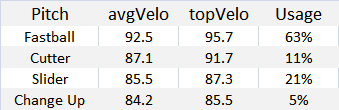
Let’s take a look at how the pitches moved. All numbers are in inches:
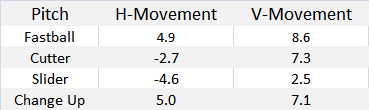
The numbers are simply averages, and particularly with the fastball, are a bit deceiving. On fastball really swings the numbers all on it’s own – likely one that got away from him in some fashion, as it’s horizontal movement was -6 inches, which is nearly 6 full inches in the opposite direction of any other fastball and nearly 10 inches from most of them. His fastball doesn’t have a bunch of horizontal movement on it, even when it was at its best on this particular night.
On the vertical plane things are a bit deceiving as well. While he wasn’t throwing a true sinker at times, there were seemingly two different fastballs. One grouping was in the 8-to-14 inch “rise” section, a true 4-seam fastball area. The other was in the 5-to-8 inch section, which isn’t quite sinker territory but a different look from his true 4-seamer.
Baseball Prospectus ran an article two winters ago using Trackman data that took a dive into what the spin rate on fastballs meant for how hitters perceived the ball and the results that generally came along with fastball spin rate. What can we tell from the sample provided on Cody Reed?
[private_subscriber]
The data essentially says that the higher the spin rate, the more swinging strikes a pitcher will get, but also the more fly balls that they will allow. The lower the spin rate, the fewer swings and misses, but the more ground balls.
The more spin on the pitch, the less the pitch “drops/sinks”. 4-seamers have more spin, and thus appear to rise (though the pitch doesn’t actually rise – that’s impossible to cause from the spin of a pitch) compared to what the eyes expect a pitch to do (which is sink – both because of lesser spin and the downward plane from the release point/arm angle).
As noted above, Reed was certainly throwing two different types of fastballs. Overall, his average spin rate was 2101, which according to the data from the Baseball Prospectus article, is below the Major League average of 2200. In the game he was as low as 1341 RPM’s and as high as 3290 RPM’s. It is worth noting that the Trackman system actually tracks the spin rate, while the Pitch F/X system estimates the spin rate based on how the baseball moves. The latter measurement is considered to be close to accurate, but the numbers may be different between the two systems.
While the data provided in the article is from the 2010-2013 seasons, at the time there wasn’t a single pitcher who averaged 3000 RPM’s on their fastball.
Using the Trackman data from the 2015 season, among the 50 pitchers with the highest average velocity there wasn’t a single pitcher who averaged 2500 RPM’s on their fastball. Average, however, doesn’t tell us everything. As we saw with Reed, some guys are throwing different groupings of fastballs. Thanks to Daren Willman’s wonderful Baseball Savant, I was able to look up just how many 3000 RPM fastballs guys threw last season. These are the truly elite spin fastballs.
There were only six players who threw more than 100 fastballs with a 3000 RPM spin rate: Jake McGee, Chris Sale, Matt Moore, EnnyRomero, Scott Kazmir and David Price. From that list, McGee, Moore and Romero really standout among the Major Leagues for the percentage of their fastballs that were thrown at such a high spin rate. McGee led the way with an incredible 33%. Romero was second at 23% and Moore in third at 15%. No other pitcher in baseball was at 10%.
Cody Reed topped the 3000 RPM mark three times out of 35 fastballs, which is good for 8.6%. On the surface that number doesn’t seem impressive, but when we look at the rest of baseball and see that only three players topped 10% in 2015, it may actually be a good rate. The small sample size of one game certainly applies here, but that can work in both directions too. Maybe he will be higher or lower than 8% in the long run – we simply don’t know at this point. We do know that in a small sample size, Reed showed an elite spin rate at times on his fastball.
[/private_subscriber]