

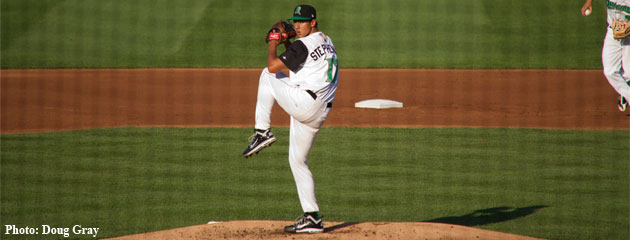

Robert Stephenson has been outstanding over his most recent two starts as he has thrown 12 innings without a walk or earned run and the right hander has struck out 16 batters. He gave credit to another Dayton Dragons starter for the improvement in his game. Sal Romano reportedly told him to just go back to his mechanics that he used in high school. I had seen Stephenson back on April 20th in Dayton where he threw 4.2 innings with 3 walks and 7 strikeouts. After seeing the comment from Stephenson about his change in mechanics I headed up to Dayton to watch him throw again. The results were outstanding as he struck out 7 in 6 shutout innings without a walk.
Stephenson is a top end pitcher and the results weren’t the reason to make the trip up to Dayton though. The main focus was to take a look at these “old, but new” mechanics that had at least in one start (and two after the game) resulted in the best results of his season and the longest outing of his career (that he matched that night as well). Here is some of the video:
So, what were these mechanical changes that Stephenson made and how did it benefit what he was able to do on the mound?
[private_subscriber]
After watching video from starts last season, April 2013 and then his most recent start in May it wasn’t very apparent to me. I watched side views and front on views in slow motion and even on a frame-by-frame basis (there are 60 frames in 1 second of video). Arm actions throughout were the same. Lower half actions were the same throughout. One thing however did jump out after repeated viewings of the clips side by side. In 2012 and in May of 2013, Stephenson was not bent over as much in his follow through as he was in April of 2013.
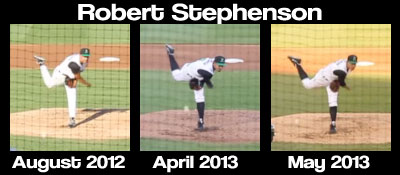
In the middle frame, Stephenson is more flat than in either of the other two frames. This was consistent through each start and in the side views from each start. Perhaps it was something in his head a little bit, as he noted at the link above, but it also has led to improved control over his pitches. Maybe it is as simple as it helps a little bit because he isn’t thinking through everything as he is releasing the ball, allowing him to repeat his mechanics and thus his release point a little better in more natural (for him) mechanics leading to stronger control.
While it is still rather early to say if this improved control is going to hold moving forward, so far it has been nothing but successful. He has been able to throw his curveball for strikes in the zone recently, something he struggled with at times earlier in the season. His fastball, which has elite velocity and that alone makes it tough to hit, has also been able to be controlled better and even a commandable pitch at times and when that happens, guys simply aren’t going to have much of a chance at this level or any level moving forward. When he can mix in control as his curveball and change up on top of that, he has all the makings of a future top of the rotation starting pitcher.
In the most recent start, Stephenson was sitting 93-97 MPH and touched 99 MPH on a scout gun in the 6th inning (it is the pitch in the end of the video that is tracked in red). He threw nine change ups in the game (the pitch tracked in blue at the end of the video). The change up was 86-89 MPH and it has more sink/tumble to it than it has extra run on it. The curveball was sitting 78-82 MPH and had a nice 11-5 breaking action to it (the pitch tracked in yellow at the end of the video). There were a few that he didn’t control well, but a majority of them were thrown in the strikezone or just off of the zone.
[/private_subscriber]