

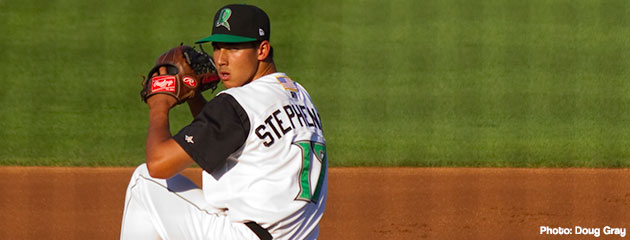

Robert Stephenson made his professional debut in front of the Pitch F/X system on Tuesday afternoon when he faced the Royals. He allowed 2 runs over 2 innings and had a strikeout. The results don’t matter much, it’s still the first week of games being played in the spring. The Pitch F/X data doesn’t mean much either because guys are working on things and still getting into game shape, but since we don’t have any past data to work with on Stephenson, it was exciting to be able to look at the data.
First, let’s take a look at the raw data:
Description | Velocity | Movement (in inches) | |||
| Player | Pitch | AVG Velo | Top Velo | Horizontal | Vertical |
| Robert Stephenson | FB | 93.8 | 96.0 | -6.3 | 11.0 |
| Robert Stephenson | CH | 86.4 | 86.4 | -5.9 | 7.2 |
| Robert Stephenson | BB | 80.8 | 82.3 | 0.7 | -1.1 |
If you look above, I have his breaking ball listed as a breaking ball rather than a slider or a curve. Pitch F/X labeled one a slider and four as curveballs, but they were slurvy according to the data, so I felt it would be a fine to just put breaking ball for now. In the past he has thrown a curveball and he very well could have been throwing one today that just happened to be slurvy, which wouldn’t be a shocker given where we are in spring training and how much of a feel pitch the curveball is. We should also note that Stephenson has been working on his 2-seamer and there did appear to be a few thrown today. The pitch didn’t show as much sinking action as you would expect from a 2-seamer.
Comparing the stuff
While Pitch F/X does give us velocity and movement, arm angles, release points and angles, sequencing, selling the pitch with your arm speed/motion, location and deception due to mechanics all can play into how effective a pitch actually is beyond just velocity and movement. Still, if we are to look at just the velocity and movement of his pitches, Stephenson’s three pitches line up well with that of Homer Bailey.
Homer Bailey has similar fastball velocity and movement on his four and two seamers. His change up overall showed more sinking action to it, but Stephenson only threw one on the day and it fell in the range of the ones Bailey threw last season while also having similar velocity. The biggest difference was with the breaking ball. Stephenson’s breaking ball fell between the slider and curveball both in movement and velocity that we see from the two pitches by Bailey. Of course since it was slurvy, that makes perfect sense.
Spinning it in rare company
One thing that Pitch F/X tracks, though it isn’t often talked about is the spin rate of the pitches. This article at Baseball Prospectus talks about spin rates if you want to read into it, but it comes down to a few things: The higher the spin rate the more often guys swing and miss the pitch and the higher the spin rate, the lower that pitch is hit into the ground. The more spin the ball has, the more rising action that it has to it.
The chart tops out at pitches greater than 2500 RPM’s. In the Baseball Prospectus article linked above, former Major League pitcher and Cincinnati native Zach Day says this about faster and slower spin rates and how they effect the pitch:
Velocity isn’t the only way to get whiffs with the fastball—you can now throw high spin into that equation. “Sneaky” is one of the terms often used to describe a fastball with average to below-average velocity that hitters still swing at and miss at an elevated rate. High spin gives hop or sneak to your fastball. It’s one of the reasons why certain pitchers can throw 90 MPH and still induce a relatively high rate of foul balls and swings-and-misses.
Lower-spin fastballs work against gravity less, causing them to sink at a higher rate than high-spin fastballs. Have you ever played catch with someone who throws a hard and heavy ball? A low-spin fastball will sink more than you expect and hit your glove closer to the palm of your hand, while a high-spin or even average-spin fastball will more likely hit your glove in the web.
Side note real quick, go read the article. It is fascinating.
Back to Stephenson, with the target spin rate of a fastball being 2500 or higher to achieve the most desired result of a swing a miss, we can look at his highest spin rate of his 20 fastballs thrown and see an impressive 3098, far and away higher than the 2500 mark. In total, 13 of his 20 fastballs were over the 2500 spin rate mark and the 20 fastballs averaged a spin rate of 2588. That average is in line with that of Aroldis Chapman (2563 in 2013).
Anyways, this was all just for a quick and fun look at the information. I don’t put too much into what we can really take away from much here aside from the spin rate of the fastball, which will carry forward. The sample size is just so small and with it being the beginning of March, guys aren’t in “season shape” yet either.