


It’s been a raging debate on the internet over the last 30 hours or so as new MLB commissioner Rob Manfred said that he would look at eliminating the shift in baseball to try and inject some offense back into the game. In a Baseball Prospectus article posted this morning it’s noted that two “sabermetric friendly” General Managers think it’s a good idea to ban the shift.
All of the talk about the shift got me to wondering though,which minor leaguer is best equipped to handle the shift. The first thing that popped into my mind was “guys who are good at bunting and use it as a part of their game” and I think that is still the best answer. But I decided to eliminate the bunts from the equation and look at only ground balls, since they are the type of ball that the shift is designed to take away hits on.
Since I do create spray charts for all of the guys in the system I had an idea of the player who went the other way the most often. That of course doesn’t automatically mean he went the other way with groundballs more than everyone else though, but in this case, it did.
I combined all ground balls to shortstop, third base and left field as “pulled grounders” and all ground balls to first base, second base and right field as “opposite field grounders” for right handers, and for left handers, it was the opposite.
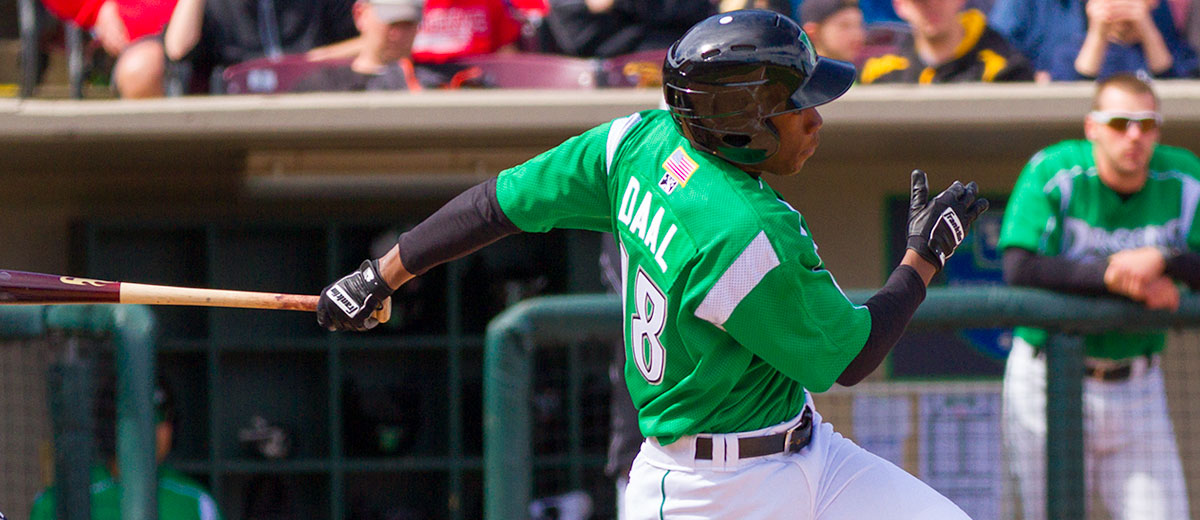
Carlton Daal had the best rates on grounders going the opposite way. The shortstop had 143 grounders in the 2014 season. 85 of those were pulled and 58 of them were to the opposite field. His 41% of opposite field grounders was tops on the list. Of course, as a right handed hitter, Daal would face the shift less often than a left handed hitter would and would be less effected even if he saw the shift as often as a lefty would because of the inability to play 80 feet deep into left field like you can play in right field (the throw is possible from right, but not from left).
Guys like Jesse Winker and Kyle Waldrop, who used the entire field well in 2014, saw their opposite field grounder rates under 30%.