


Michael Lorenzen had a bit of a rough go in his Major League debut last week, allowing three solo homers and eight hits in 5.0 innings. He had just one walk and struck out five batters in the game, but he was hit hard more than a few times in the game and battled his control throughout the game despite walking just one batter.
Last night the right hander would make his second big league start and it went much better. Hitting the road and taking the mound in Pittsburgh was what Lorenzen needed to pick up the first victory of his big league career. He went into the 7th inning, but he didn’t record an out, finishing with a final line of 6.0IP, 3H, 1ER, 3BB and 4K.
Unlike his debut, Lorenzen was able to keep the ball on the ground. Of the 13 outs recorded by non-strikeouts in the start, 10 of them were on the ground. The movement on his four pitches was the same, but his velocity was up. He averaged 95.8 MPH on his fastball (topping out at 98), up nearly a MPH from his debut. That’s elite level velocity that would rank among the best in the game if he had enough innings to qualify as a starter.
Perhaps the biggest difference though was the location on which hitters made contact on his pitches in the two games. Below is a chart showing the pitch locations of all batted balls (not including fouls) from his 1st two starts.
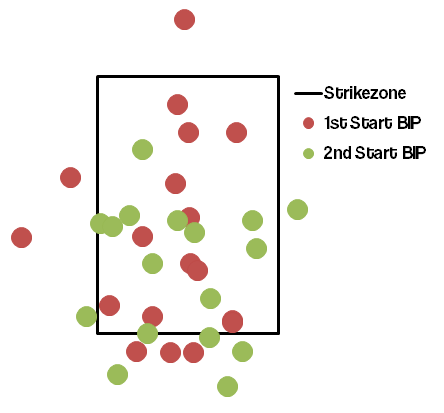
As you can see from the image above, things were much lower in the zone overall than in his first outing. Given what we’ve been able to see in his minor league career, that is more likely to be the norm than what his first outing showed, where he was up in the zone more often than not and giving up batted balls in the air rather than on the ground.
After having an incredibly high 18 swings and misses in his debut, Lorenzen had nine in his second outing. That is only half of the number he had the first trip out, but it’s a solid rate of swings and misses (and shows how impressive the 18 were in the first start).
Lorenzen did change up his pitch selection some in his second start. He was caught by Tucker Barnhart in his first game, with Brayan Pena catching the second outing last night. With different teams and different catchers, there are a lot of variables that go into pitch calling, but from the first start to the second it seemed that the right hander traded a few extra sliders for fastballs. Here’s his pitch selection breakdown from the two starts:
| Fastball | Change Up | Slider | Curve | |
| 1st Start | 62.62% | 10.28% | 18.69% | 8.41% |
| 2nd Start | 69.89% | 9.68% | 11.83% | 8.60% |
The change up and curveball rates remained almost identical with only the total number of pitches altering the slight differences in selection. The slider drop off represents the exact gain in more fastball usage. Perhaps it was a result of the Pirates lineup, or maybe it was a conscious decision by Pena and Lorenzen to attack with the fastball more given that he was controlling it better this time around and that he was averaging 96 MPH with the pitch. Whatever the reason was, it worked.
Two years ago on this date, Michael Lorenzen was an outfielder that moonlit as a closer at Cal State Fullerton. It’s been a quick trip through the minors and into the big leagues for the right hander, but it’s been a fun ride to watch the development from reliever to starter in such a short period of time.