

Amir Garrett was signed out of high school in the 2011 Major League Baseball draft by the Cincinnati Reds to a two-sport contract that allowed him to play college basketball and paid him a signing bonus of $1,000,000 over several seasons if he stuck with baseball. He was considered, as you would expect of someone going on to play college basketball and professional baseball, an excellent athlete, but a very raw baseball player.
The reasoning for that was fairly simple: He didn’t have nearly the same amount of time on the field, or in his case, the pitching mound, as a large majority of his high school pitching counterparts as he was focusing more on basketball as one of the Top 50 high school players in the country.
Amir Garrett wouldn’t pitch in 2011 and he pitched sparingly in the 2012 season for the Arizona League Reds where he made seven appearances and then two more appearances with the Billings Mustangs, totaling just 20.0 innings. He walked 13 batters in that span, a sign of his rawness, but also struck out 18 batters that showed the raw stuff he possessed.
In the 2013 season the big left hander began the season with the Billings Mustangs in late June and a month later was pitching for the Dayton Dragons. Between the two stops he would throw 57.2 innings with 26 walks and 32 strikeouts. He struggled at times, particularly with Dayton as he posted a combined 5.15 ERA between the two levels.
In 2014 he returned to Dayton and took a big step forward. Garrett threw 133.1 innings with a 3.64 ERA for the Dragons and during the season decided he would give up on playing college basketball to focus on pitching. It really paid off as he put together what was easily his best season, walking 51 batters and striking out 127 opposing hitters. His walk rate of 3.4 batters per 9 innings pitched was easily the best of his short career and his strikeout rate was also the best he had with an 8.6 strikeout per 9 innings pitched.
Last season was just as good on the peripheral standpoint as his walk and strikeout rates were almost identical to the 2014 season, but pitching for the Daytona Tortugas in the Florida State League that is known to really suppress power, he allowed just four home runs in 140.1 innings pitched. That combination led to a 2.44 ERA, which was the 2nd best mark in the league.
Since he’s really come into his own as a pitcher, there have been two minor warts on the resume for Amir Garrett, which were talked about in his scouting report after last season when he was ranked as the organizations 4th best prospect. The first is that his walk rate has been a tad higher than you’d like. Generally speaking, you want a walk rate for a starting pitcher to be under 3.0 walks per 9 innings pitched and he’s been at 3.5 and 3.4 over the previous two seasons. The other has been that he’s not used a change up often enough and it’s a pitch he’s going to need to develop further to remain a starting pitcher in the long run.
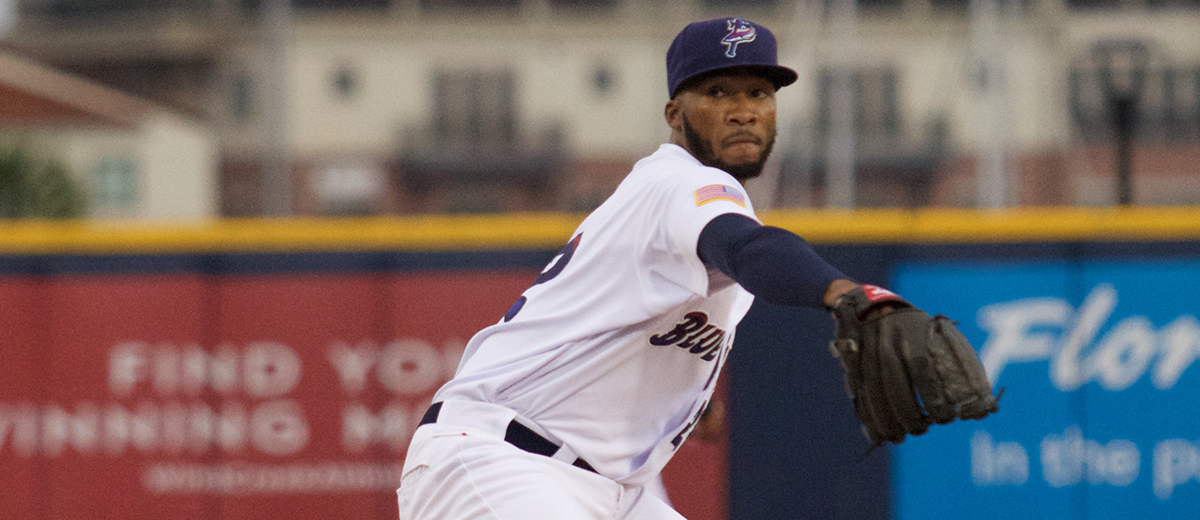
That all brings us to the 2016 season. Through five starts the left handed starter has posted a 1.52 ERA in 29.2 innings for the Double-A Pensacola Blue Wahoos. He’s walked just six batters and he’s struck out 32. Garrett also has yet to allow a home run. To say that things are going well would be an understatement.
Small sample size alert warning, but as things sit right now, Garrett has walked just 1.8 batters per 9 innings pitched this season, nearly half of his best rate he’s ever posted in a previous season. He’s also striking out 9.7 batters per 9 innings pitched, a big step forward from an already strong career strikeout rate.
The improvement in the walk rate is significant, and if he can continue to keep it low (and not even this low, though that would be an enormous improvement) we could see him rocket up the midseason prospect rankings for the second season in a row.
Let’s take a deeper look into how he’s been getting things done early on this season.
Amir Garrett Scouting Report
[private_subscriber]
Fastball: The pitch is working in the same range that it has in the past – sitting in the low 90’s and touching the mid 90’s on occasion. What has stuck out with the pitch more this season has been better control of the offering.
Slider: This pitch had been his go-to pitch in the past, and it remains the way. It comes in around 78-84 MPH depending on the day and it shows itself as a potential plus pitch. Early this season it’s been more consistent than it was in the past, showing itself more above-average than average. Just as important though, he’s able to throw the pitch closer to the strikezone than he has in the past, giving more advanced hitters a second though about whether it’s going to be a strike or not. In the past he struggled a bit to do this consistently, but less advanced hitters would chase it. That he made the adjustment without having to go through the struggles of seeing more advanced hitters not expand the zone on it is huge.
Change Up: This was the big knock on Garrett in the past and while the offering is still a clear third pitch, and can still be a bit too firm at times, he’s showing more trust in the pitch. He’s also showing better arm action with the pitch this season.
It’s still early in the season, and Amir Garrett has made just five starts, but the jump to Double-A is usually the biggest one until you reach the big leagues. So far, the lefty has passed the jump with flying colors and then some. He’s taken steps forward in several areas and has been dominating the level. The change up will still need to come forward, but the fact that he’s already throwing it more and with more confidence is a step in the right direction.
[/private_subscriber]