

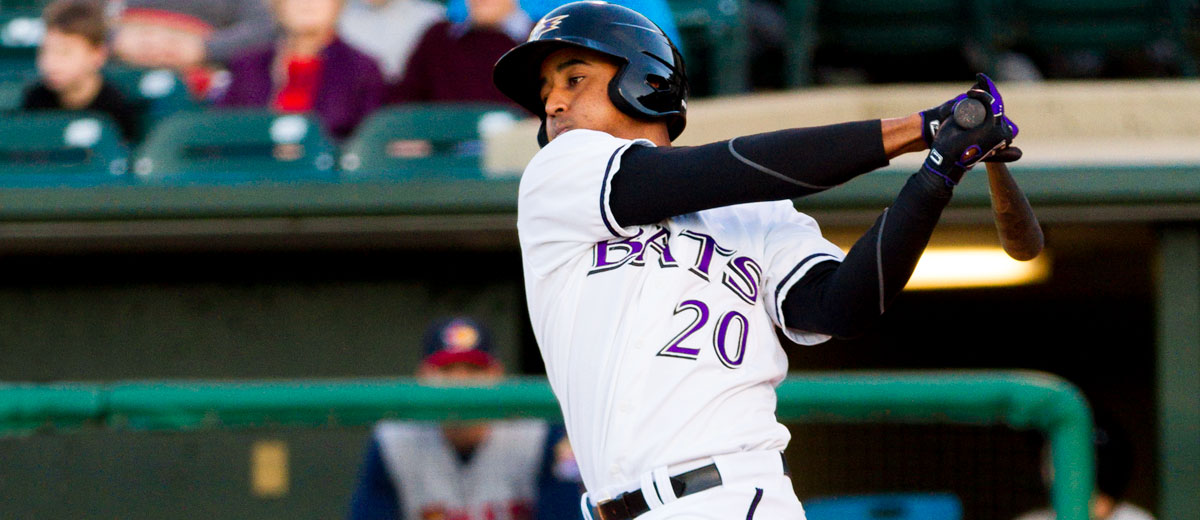

The 2014 season was a breakout one for Yorman Rodriguez, sort of. His break out was hidden by a flat out terrible May where he hit .139/.184/.208. He started the month on the disabled list with an oblique strain and when he came back, he struggled mightily for a few weeks. Outside of May, the 21-year-old (at the time) hit .286/.358/.423 with 43 walks and 91 strikeouts.
The real breakout came in the second half, August specifically. In August he would hit .294/.408/.529 where he walked 20 times. It was easily the most he had ever walked in a month and also the best OPS for a month he had ever posted (where he had 40 at-bats).
All stats listed below are coming into Tuesday night
In 2015 he has had some struggles at the Triple-A level. Rodriguez is hitting just .240/.273/.429 overall, for an OPS of .702. The International League has an average OPS of .685, though it’s more heavily titled toward on-base percentage and lesser towards slugging. Either way, the now 22-year-old has been roughly a league average bat while being five years younger than the average player in the league.
His May has been a bit of a turnaround, as he’s hit .267/.290/.500, but that line has also come with just three walks and 28 strikeouts. The power has been there in a big way, but it’s been all or nothing as he’s had 12 extra-base hits on the month with 12 singles to go with those three walks. The power output is good to see, it’s a part of his game that’s always teased itself over the years but hasn’t really been put together over long periods of time.
[private_subscriber]
In April, when he wasn’t hitting for much power, Rodriguez was pulling the ball to the outfield far more often than he had in the past. In May he’s gotten back to using the entire field in his approach and four of his extra-base hits have come to right or right-center.
Where Rodriguez needs to make his biggest improvement is being more patient at the plate. Watching the games, he seems to have a good enough eye. He isn’t swinging wildly at pitches way out of the zone, he’s just swinging often. I’ve gone back over his pitches seen data from the last two seasons (this data is available for both Double-A and Triple-A now). Let’s take a look at what it looks like:
| Month | CalledK | SwingK | Foul | Ball | Take |
| Apr-14 | 10.4% | 17.5% | 21.9% | 30.3% | 40.7% |
| May-14 | 9.2% | 22.5% | 20.7% | 30.6% | 39.9% |
| Jun-14 | 13.1% | 11.8% | 20.7% | 35.9% | 49.0% |
| Jul-14 | 14.1% | 13.9% | 18.7% | 33.1% | 47.2% |
| Aug-14 | 11.3% | 16.2% | 19.2% | 37.9% | 49.2% |
| Apr-15 | 12.3% | 13.6% | 20.8% | 32.2% | 44.5% |
| May-15 | 14.0% | 16.4% | 20.1% | 31.9% | 45.9% |
The “CalledK” and “SwingingK” just represents a strike, not the end of an at-bat. Looking at the chart above we can see that in April and May of 2014 he was swinging an awful lot, taking just over 40% of the pitches he saw. Over the next three months he began to take more pitches and consequently put up the best run of his career.
In the 2015 season so far, Rodriguez is in between the first part of last year and the second part of last year in how many pitches he is taking. Taking more pitches in itself isn’t always the best plan, you shouldn’t take hittable pitches. But the best hitters in the game tend to swing at fewer overall pitches and only swing at the best pitches to hit rather than any pitch they can simply put the bat on. When Rodriguez was at his best, he was taking a few more pitches.
Let’s also take a look at the swinging strike column. April and May of 2014 were the worst among the entire sample. Since then he’s been at 14.5%, which both August of 2014 and May of 2015 just over 16%.
Using the 14%+ swinging strike rate as a baseline, granted it could improve given he’s just 22-years-old (though it could also get worse as he’s still in the minors and not facing big leaguers just yet), let’s see how that group is performing for the 2014-2015 seasons as Major Leaguers who also fall into that category:
| Name | SwingK% | OPS |
| Jose Abreu | 14.20% | .929 |
| Alex Rodriguez | 14.60% | .907 |
| J.D. Martinez | 15.40% | .882 |
| Kris Bryant | 15.60% | .873 |
| Carlos Gomez | 14.30% | .826 |
| Jorge Soler | 14.20% | .800 |
| Matt Kemp | 14.00% | .797 |
| George Springer | 17.40% | .796 |
| Evan Gattis | 14.20% | .769 |
| Avisail Garcia | 18.10% | .765 |
| Chris Carter | 16.50% | .754 |
| Marlon Byrd | 16.20% | .754 |
| Colby Rasmus | 14.70% | .750 |
| Oswaldo Arcia | 17.70% | .747 |
| Josh Hamilton | 19.20% | .740 |
| Ryan Howard | 15.80% | .725 |
| Chris Davis | 15.40% | .710 |
| Mark Reynolds | 15.10% | .690 |
| Carlos Gonzalez | 14.80% | .683 |
| Danny Espinosa | 15.70% | .680 |
| Tyler Flowers | 15.90% | .669 |
| Jarrod Saltalamacchia | 16.30% | .661 |
| Chris Johnson | 15.20% | .658 |
| Mike Zunino | 18.00% | .651 |
| B.J. Upton | 15.20% | .620 |
| Jon Singleton | 15.10% | .620 |
There are plenty of successful hitters in there, and there are some really clunkers as well. What seems to separate the good from the bad in this group seems to be power, walks or both in a few cases. Baseball has taken a big turn towards pitching in the past few years, with the National League OPS sitting at .698 over the last two seasons. The offensive threshold to be a solid player has really dropped off.
Rodriguez is beginning to show real signs of having a power breakout. The next step is to get back to a more patient approach and up his walk rate. We’ve seen him do that in the past, although it was in a small sample size of just 2-3 months. If he’s able to combine the upping of his power output along with an upped walk rate, even just a small uptick, it would be a big improvement. Cutting down on the rate in which he swings and misses would also help, but that isn’t as important as drawing a few more walks would be.
[/private_subscriber]