

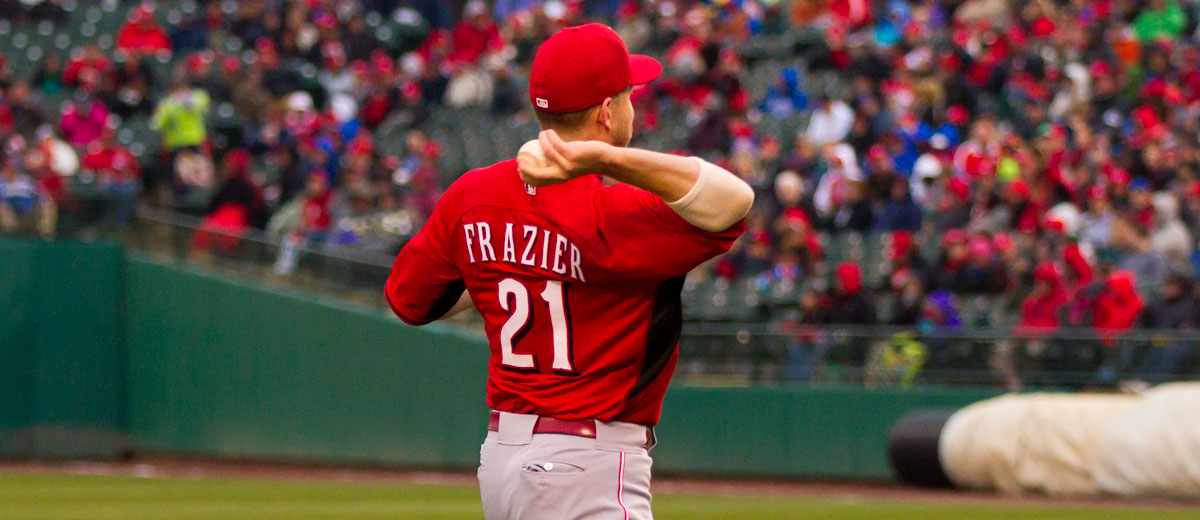

Todd Frazier was the toast of the town in the first half of the season. The Cincinnati Reds third baseman was hitting .297/.363/.641 on June 19th. His 1.003 OPS was the peak for him during the season. At that point in the season he had 20 doubles, a triple and 22 home runs. Frazier was in the running for an MVP award at that point in time, granted it was still a very long way from the end of the season.
Since that day though, the script has really flipped for Frazier. He’s gone from one of the best hitters in the league to a well below-average hitter. Since June 20th, the Reds third baseman has hit an abysmal .228/.272/.405. The power has dropped off, but has still been solid (IsoP through June 19th was an incredible .345. Since then it’s been just .177 – a good, but unspectacular number). His ability to hit for average and to get on base have fallen off dramatically.
Overall on the season Frazier has been productive, posting an .816 OPS and a 119 OPS+ (which means he’s been 19% better than the league average in OPS after adjusting for all of the ballparks he’s played in this season). The split though has been a tough one to watch. Todd Frazier has essentially gone from being Mike Trout on offense to being Salvador Perez. The question is, what has led to such a gigantic drop off in production?
Let’s take a look at some of the easier things to look at first:
| Split | AVG | OBP | SLG | BB% | K% | BABIP |
| April-June 19 | .297 | .363 | .641 | 7.7% | 18.3% | .295 |
| June 20-Today | .228 | .272 | .405 | 5.6% | 20.7% | .253 |
Two things jump out here. In the early part of the season Frazier was walking a bit more and striking out a bit less. Neither was a huge decline in the second half, but overall it led to his strikeout-to-walk ratio going from 2.38 to 3.70. That takes him from a solid rate to a well below-average rate. Then there is the drop off in batting average on balls in play that dropped off 40 points. When you put the two things together it explains a lot of the struggles.
Let’s take a look at his plate discipline rates to see if there’s a reason he’s walking less and striking out more.
| Split | In Zone | Out of Zone |
| April-June 19 | 68.5% | 37.3% |
| June 20-Today | 77.9% | 44.1% |
In the first half, Todd Frazier was swinging significantly less often both in the strikezone and out of the strikezone. He was being more patient early and he’s been far more aggressive in the second half. Aggressiveness at the plate isn’t necessarily a bad idea, particularly in the zone. But being aggressive outside of the zone is very bad. When we couple being more aggressive out of the zone along with the picture starts to form. Let’s look at how he’s performed in and out of the zone in the span in terms of average and slugging percentage.
| In Zone | Out of Zone | |||
| Split | AVG | SLG | AVG | SLG |
| April-June 19 | .336 | .836 | .252 | .452 |
| June 20-Today | .295 | .524 | .167 | .298 |
Not surprisingly, he was significantly better in the first half no matter how it’s sliced. We may not really know if being more aggressive, particularly in the zone, came into play or not. But we can probably say that being more aggressive outside of the zone has led to overall worse numbers.
Lastly, I’d like to look at his exit velocity for the two timeframes. It needs to be noted that only about 70% of the balls hit have an exit velocity, so there is some data missing from both samples, but both seem to be large enough to make up for the missing plays.
| Split | Exit Velo | <80 MPH | >90 MPH | >100MPH |
| April-June 19 | 92.57 | 14.5% | 64.1% | 31.3% |
| June 20-Today | 88.69 | 22.6% | 53.2% | 21.1% |
Not surprisingly, swinging at better pitches in the first half led to harder contact across the board. He had a lower rate of contact that resulted in less than 80 MPH, a higher rate of contact that resulted in over 100 MPH. His rate of contact between 90-99 MPH was lower (the above chart shows greater than 90 MPH, but that also includes the 100+ MPH group), going from 26.7% to 31.6%.
The league average rate for exit velocity is just over 88 MPH. So in the second half, when he makes contact, Todd Frazier has been roughly league average in terms of how hard he has hit the ball. Of the 252 players with at least 150 data points this season, the 92.57 MPH he averaged in the first half would rank as the 17th best. By comparison, the 88.69 MPH mark would rank 147th in that same group.
While there is probably some regression to the true talent level at play for Todd Frazier, it’s easy to look and see that his swinging at a lot more pitches in the second half has resulted in a decline in production. He’s swinging and missing more often. He’s walking less. Both of those are a direct result of poorer pitch selection. The swinging at worse pitches (out of the zone rate is way up) has also likely led directly to him hitting the ball significantly softer, going from an elite rate of exit velocity (Top 7% in the league) to a mediocre rate of exit velocity (Top 51% in the league). Picking better pitches to hit (and swing at to begin with) will help get him moving in the right direction. It’s too late this season to make an adjustment with just a few games left. However, when he looks back at his 2015 season as he prepares for 2016, that should be the biggest thing he should look at and try to work on.