


For all 2016 Prospect Ranking Scouting Reports – click here (these will come out one a day over the offseason).
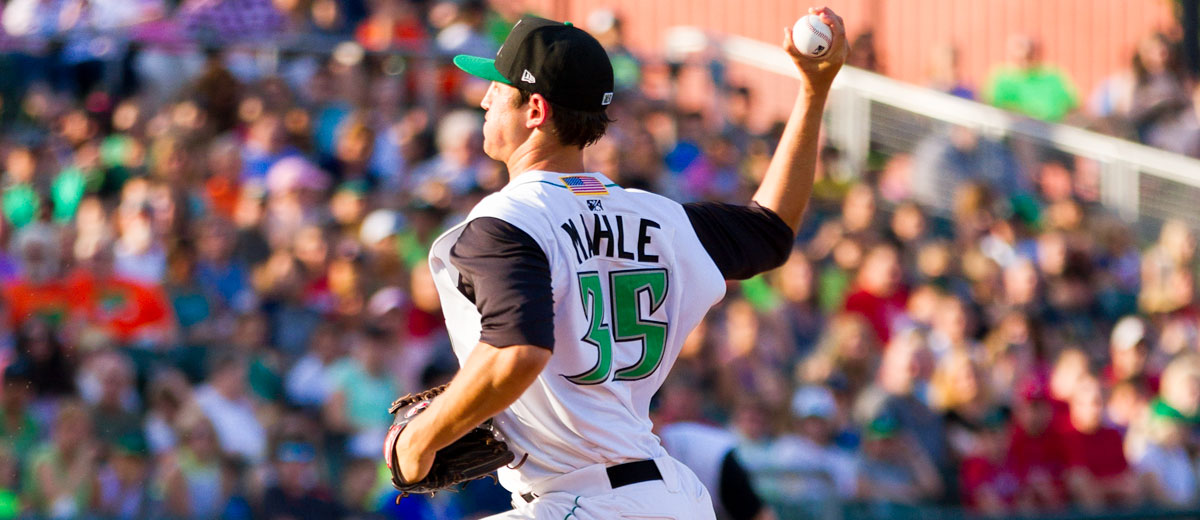
Tyler Mahle started out his season by allowing just one run over the course of 5.0 innings with a walk and two strikeouts in his Dayton Dragons debut. His next start was even better as he fired 6.2 shutout innings with five more strikeouts. The right hander would have a hiccup the next time out, allowing four runs in 4.0 innings against Lansing. He would rebound in his final April start, allowing just two runs over 7.0 innings with eight strikeouts. He would finish the month with a 2.78 ERA in 22.2 innings with just three walks and 16 strikeouts.
May got out to a rough start. On the 2nd the Great Lake Loons would rough Mahle up for seven runs in 4.0 innings, including two home runs. Things would go a little better the next time out, but the defense let him down some as he’d be charged with three unearned runs and two earned runs in 5.0 innings. Things would turn around quickly though. Over the next four starts he would allow just three earned runs in 26.1 innings (1.03 ERA) with just two walks, two home runs allowed and he had 27 strikeouts. He would finish the month with a 3.06 ERA in 35.1 innings with just five walks and with 38 strikeouts.
Mahle would carry that finish forward into June. In his first start he would throw 7.0 shutout innings with a walk, two hits and eight strikeouts. The next two starts were more of a struggle though, allowing seven runs in 9.0 innings. He would finish the month on a strong note, allowing just three earned runs in 11.0 innings over two starts without a walk and with 14 strikeouts. The month of June would finish with a 3.33 ERA in 27.0 innings with three walks and 30 strikeouts.
July got out to a strong start as Mahle tossed 6.0 shutout innings at Fort Wayne with two walks and three strikeouts. Things started that way for the entire month. In his next two starts he would allow a run over 6.0 innings in both games before making perhaps the best start of the season. On July 20th he faced Fort Wayne at home and threw 7.0 shutout innings with nine strikeouts. The month would finish up with another strong start, allowing just one unearned run over 6.0 innings. In 31.0 innings he would post a 0.58 ERA without a home run, five walks and 21 strikeouts.
The right hander would make seven starts in August and September. In his first start he’d give up three runs in 6.0 innings with eight strikeouts. The next time out was a little more of a struggle as he’d be charged with three unearned runs to go along with two more earned runs in 6.0 innings. The Reds began to limit his pitches at that point to try and keep his innings in check as the season wound down and he’d toss 4.0 innings in the next two starts, allowing just two earned runs in total. Over his final three starts he would allow just three earned runs in 16.0 innings to finish up the stretch with a 2.50 ERA in 36.0 innings, nine walks and 30 strikeouts.
The right hander finished the year with a 2.43 ERA and he would bring home the Midwest League Pitcher of the Year Award. In 152.0 innings he would show outstanding control, walking just 25 batters and he would strike out 135 batters with just seven home runs allowed.
| ERA | IP | H | HR | BB | K | WHIP |
| 2.43 | 152.0 | 145 | 7 | 25 | 135 | 1.12 |
Scouting Report
[private_subscriber]
Fastball | Early in the season the right hander was sitting 89-91 MPH and was touching 93. By the time the season ended he was working in the 90-93 range and would touch 96 every now and then. He doesn’t get great movement on the pitch, but he can locate it well and add or subtract velocity well.
Curveball | The pitch is still a little inconsistent, coming in at 70-75 MPH. When it’s at its best it shows good 12-6 breaking action and is a slightly above-average pitch. At times though it can get a little slurvy and is more of a floating breaking ball.
Change Up | Working in the low 80’s, the pitch has some armside run and sink to it. It’s the third pitch in his arsenal, but he’s confident in using it when he needs to. It’s an average offering.
Armed with three pitches that project to be at least average and above-average control, Mahle took several steps forward in the 2015 season. He built up his innings and picked up velocity, going from a fringe average velocity guy to an average velocity with above-average flashes. Mahle is about as advanced as a 20-year-old can be. He knows how to mix-and-match well, can change the velocity on his pitches and he can pound the strikezone on most nights. While his upside isn’t that of a top of the rotation arm, he’s got a middle of the rotation ceiling and that seems like a relatively safe bet given that he’s yet to pitch in Advanced-A ball.
[/private_subscriber]