


Last night the Cincinnati Reds called up right handed pitcher Jon Moscot to step in for Raisel Iglesias, who has an oblique injury. His final line was: 5IP, 4H, 4ER, 3BB and 3K. Overall, it wasn’t a good start, but it was the first inning that really did him in. He allowed three runs in the first inning and walked three batters. Moscot usually throws strikes, and he did so after that first inning, so it’s probably fair to say that he was dealing with all kinds of nerves out there and settled in after that. Let’s take a look at the strikezone and all of his pitches from the start. I’ve broken them down by pitches in the first inning versus pitches he threw in the rest of the game.
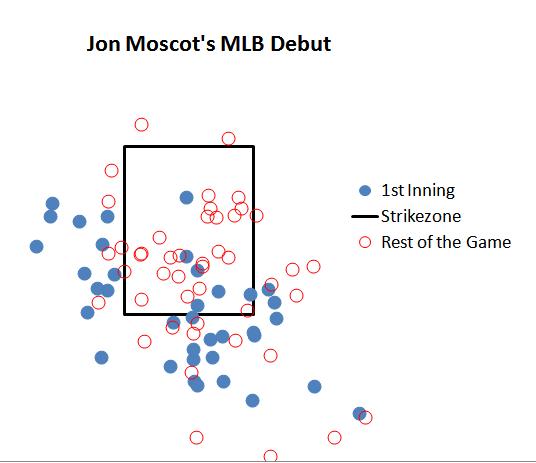
If you look at the strikezone there were only five pitches that were clearly, fully in the strikezone out of the 37 pitches he threw in the inning. A few more are touching the edges of the zone, but could have gone either way. The rest of the game 22 pitches completely in the strikezone out of the 48 pitches he threw. So, in the first inning, Moscot threw for sure strikes on just 14% of the pitches he threw. The rest of the game saw that rate jump to 46%, which is a strong rate (guys chase pitches – so you don’t want to be in the zone too much). The difference in control was much, much better. That jives well with the scouting reports for the right hander and is probably a lot closer to what we will see moving forward than what we saw in the first inning.
The first inning falls into the “bad” category. It was ugly. No control and two earned runs isn’t how anyone wants to begin their big league career. Things flipped over to the good side of things after that. While he did allow two solo home runs in the game moving forward, two runs over the next four innings where he needed just 44 pitches and had two strikeouts certainly falls into the “good category”.
Pitch Usage and velocity
Moscot is a four pitch guy, throwing a fastball, slider, curveball and a change up. He used all four in the debut, though he worked mostly with the fastball and the slider, mixing in a handful of change ups and sliders. Here’s the breakdown:
Pitch | Use | avgVelo | maxVelo |
| Fastball | 61.4% | 92.4 | 96.3 |
| Slider | 25.3% | 82.8 | 85.3 |
| Curveball | 8.4% | 77.1 | 78.6 |
| Change Up | 4.8% | 82.3 | 82.6 |
I was surprised to look back at the data and find that he topped out at 96.3 MPH. The highest I’ve seen, granted I don’t get radar reading on every start, has been 94 MPH. While I’ve seen 94 from him plenty, it’s never been higher in my viewings. It’s worth noting as well that of the fastballs that were thrown, a majority of them were four-seam fastballs, but there were a handful of two-seam fastballs mixed in as well.
Overall
You never know exactly what you are going to get in a big league debut from guys. Between the nerves of finally achieving their lifelong dreams, to a stadium with more fans in it than they’ve probably ever played in before to facing the best hitters on the planet… it’s always a big unknown. For Moscot, the first inning is one that he’d like to forget, but he stayed poised and put it behind him and finished out strong. That’s a good sign that he didn’t wilt under the pressure or let things get to him. He showed good control of the strikezone after that first inning and showed velocity that, at least I hadn’t seen before, even if it was just one pitch. It wasn’t a great debut by any stretch, but there was plenty of things to see in the start that fall into the good category and after that first inning ended and he got settled in, there wasn’t much to toss into the bad category.