

When the Cincinnati Reds traded for Scott Schebler last offseason there was a range of opinions on exactly what he was or what he could be. Prior to 2015, Schebler had showed off the ability to beat up minor league pitching. He OPS’d over .900 in both Advanced-A and Double-A in 2013 and 2014. He went to the Arizona Fall League in 2014 and hit .310/.352/.524 over 23 games.
Then 2015 happened. He battled through injuries during the season and struggled mightily in Triple-A, hitting just .241/.322/.410 for Oklahoma City in the hitter friendly Pacific Coast League. Despite that he got a late season call up with the Dodgers and held his own, showing off some pop in his bat while hitting .250/.325/.500 with three home runs in 40 plate appearances.
The stumble at Triple-A left many concerned about whether or not he was simply a guy who couldn’t make the jump up in competition. Schebler had a good spring training, hitting .288/.354/.525 in 23 games and made the team, though he didn’t win an every day spot. Early on he was splitting time with Adam Duvall but it wasn’t long before Duvall was getting a majority of the playing time as Schebler struggled. After the game on May 7th he was hitting just .188/.246/.344 and was sent to Triple-A.
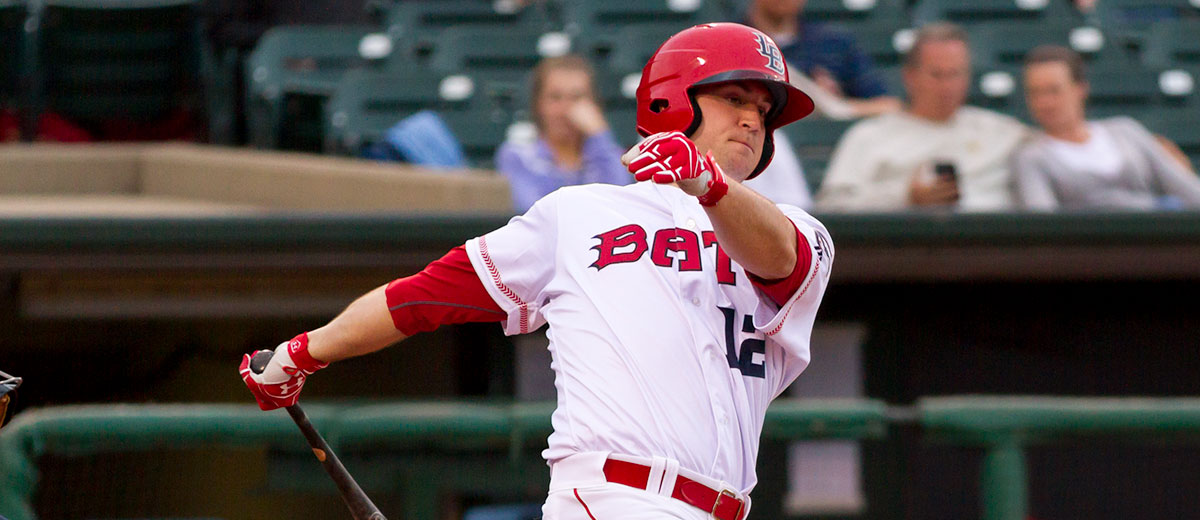
In Louisville things got out to a bit of a slow start, but it didn’t last long and after 11 weeks he had gone crazy in the International League, hitting .311/.370/.564 for the Bats with 18 doubles, eight triples and 13 home runs in just 75 games. He had put the 2015 Triple-A season behind him, but he still had to show that he could perform in the big leagues. At age 25, and with one of the top prospects in the organization also fighting for a corner outfield spot, the August 2nd call up may have been a do-or-die situation for Scott Schebler.
When the Reds traded Jay Bruce they immediately inserted Schebler into their every day lineup. He would come up and immediately make his presence known. He went 3-5 and hit a walk-off home run against the Cardinals. In the 3-game series against St. Louis he went 5-11 with a double and a home run. It was a good start, but then he went out and had an 0-27 slump over the next eight games. It wasn’t a good sign and people were left again wondering: Is this the step that Scott Schebler can’t make? Is the big leagues just too big of a step up in competition?
Over the next 27 games he’s put all of that behind him. Since August 15th he’s gone out and hit .340/.410/.532 with three doubles and five home runs. More impressively is that in those 105 plate appearances he’s drawn nine walks and he’s struck out just 14 times.
.280/.362/447. That’s what Scott Schebler has hit since he was called up on August 2nd. .188/.246/.344 is what Scott Schebler hit in the first part of the season with the Cincinnati Reds. Let’s dive into some of the differences.
| PA | AVG | OBP | SLG | BB% | K% | |
| April-May | 69 | .188 | .246 | .344 | 7.2% | 29.0% |
| August-Sep | 149 | .280 | .362 | .447 | 8.7% | 17.4% |
When looking simply at the production above we can see the big difference really comes in lowering of the strikeout rate. He’s gone from a well below-average contact hitter, granted in a small sample size, to a guy who, for a power hitter of sorts, is an above-average contact hitter. His walk rate also took a small step forward. When you put the two together the magic really starts to happen. Strikeout-to-walk ratio is important for every hitter and going from 4-to-1 to 2-to-1 will do wonders.
The plate discipline numbers are better beyond just the walk and strikeout rates. In April and May he expanded the strikezone 40.4% of the time, while that number has dropped to 35.1% of the time since he was recalled (these numbers won’t match up with what you will find on Fangraphs – they aren’t perfectly accurate as they are done manually by looking at the zone profiles on Brooks Baseball).
He’s gotten more patient on pitches outside of the zone, but he’s also gotten more aggressive on pitches inside of the strikezone. In April and May he was swinging at strikes 75.6% of the time. Since he’s been recalled that has jumped up to 82%.
The turn around for Scott Schebler has been fun to watch. Statistically we can tie it to controlling the strikezone better. He’s swinging at fewer bat pitches and he’s swinging at more good pitches. In the long run that’s going to help every hitter out. The strikezone is the strikezone for a reason – it’s where a batter is expected to be able to hit the ball with some sort of authority. Swinging at more of those types of pitches and less of the ones that you aren’t expected to be able to do with leads to good results.
We are still dealing with somewhat of a small sample size here, but Scott Schebler is showing real signs of improvement. Whether he can continue along that path is another story, but he’s taken step one.